

A manufacturing company held a special lecture on generative AI... formed an AI adoption task force and is promoting in-house LLM.
Updated: Aug 5
Starting with three days of training with Rebot, the formation of an AI adoption task force at a manufacturing company , the introduction of in-house LLM, and the promotion of DX and AX have all begun in earnest.

From May 14 to 16, REVOT conducted a three-day special lecture on generative AI for employees of a manufacturing company.
This training did not end with merely understanding generative AI technology and trends. Following the training, the company formed a task force for AI adoption and decided to implement in-house LLM and promote DX and AX.
The process is currently actually underway.
This post is not a training review introducing the courses Rebot conducted. It is a record intended to document the initial process and starting point where generative AI training led to a manufacturing company's actual decision to adopt AI.
Why did a certain manufacturing company start generative AI education?
The company was aware that generative AI could improve work efficiency, but felt burdened by the prospect of applying it to actual operations.
The biggest reason was internal company data.
Manufacturing companies possess technical data, process information, client-related data, and internal know-how that must not be leaked externally. Even if they wish to utilize generative AI in their operations, it is difficult to easily decide to input such data into external services.
“Is it okay to input our company’s data?”
This question is a problem that many companies looking to adopt generative AI actually face. They recognize the need for AI, but are unable to move toward actual use due to concerns about data leakage.
This special lecture started right at this point.
What was covered in this special lecture on Generative AI?
This special lecture was held over three days.
On the first day, we examined why we need to understand the changes in AI right now. We confirmed together that generative AI is not a passing fad, but a change that is transforming the way companies and individuals work.
On the second day, we examined how AI is transforming industries and work. We discussed the potential impact of generative AI on actual business operations and the perspective from which companies should view these changes.
On the third day, we discussed together what the company needs to prepare for the future. Going beyond simply determining whether generative AI could be used, the discussion led to a session on how the company should begin adopting AI at the corporate level.
schedule | Educational Topic |
|---|---|
Day 1 | Why We Need to Understand the Changes in AI Now |
Day 2 | How AI is changing industries and work |
Day 3 | What should our company prepare? |
The purpose of this training was not to teach employees a new tool.
It was more important to understand with employees the reasons and direction for adopting AI, and to build a consensus that could lead to actual implementation.
How did employees view the introduction of AI?
At the beginning of the training, employees had realistic concerns along with the potential of AI.
We agreed that generative AI can process tasks faster, organize data, and support various tasks.
However, there were also concerns about whether company data could actually be input into the AI, whether there was a possibility of information leakage, and whether the AI might take over their work.
This reaction was closer to a demand to know the conditions under which it can be used safely and realistically, rather than an attitude of rejecting the adoption of AI.
Simply deciding to adopt AI does not mean that employees can utilize it in their actual work. It requires a process in which employees first understand the necessity of change and accept what AI means for their work and the company.
What has changed after the 3 days of training?
As the three-day special lecture on generative AI progressed, the questions and perspectives of the employees gradually changed.
Before the training, there was a strong perception that "it is difficult to use AI in our company."
After the training, the question began to shift to, “If we create an environment where it can be used safely, to what extent can our company utilize AI?”
Vague anxiety has turned into a concrete review.
The perspective on AI has shifted from viewing it as an unfamiliar external technology to seeing it as a business tool that our company actually needs to prepare.
The most important outcome of this training was not that specific skills were learned.
It was that the company and its employees jointly understood the necessity of adopting AI and began discussing what actually needed to be prepared.
How did education lead to the formation of the AI Adoption Task Force?
Following this special lecture on generative AI, the company decided to form a task force to introduce AI .
The company did not have a separate in-house IT organization. Therefore, this TF team is significant as it is the first organization within the company dedicated to discussing the adoption of AI.
The AI Adoption Task Force served as a starting point for gathering opinions scattered across departments and discussing together the direction in which the company would adopt AI.
It has become clear through training that for employees to understand the changes in AI and for the company to take actual action, an entity is needed to continue internal discussions.
This special lecture did not end with the education.
A change in the perception of employees led to an organizational decision, which in turn led to the actual action of forming an AI implementation task force.
Why did a certain manufacturing company decide to implement an in-house LLM?
The biggest reason the company hesitated to use generative AI was the possibility of internal company data being leaked externally .
To apply AI to actual business operations, internally accumulated data must be utilized rather than externally disclosed information. However, it is difficult to achieve sufficient utilization by inputting sensitive information into external AI services.
The introduction of an in-house LLM was discussed as a way to resolve this issue .
In-house LLM refers to enterprise-specific AI utilized within a company's internal environment. It is a method that creates an environment where employees can leverage AI based on internal data, while reducing the burden of directly inputting company data into external services.
Through this training, the company shifted its mindset from the perception that "AI cannot be used due to information leakage" to the view that "we just need to create an environment where it can be safely utilized within the company."
As a result, the introduction of an in-house LLM led to an actual implementation project.

How does the implementation of in-house LLM connect to DX and AX in the manufacturing industry?
The company did not view the implementation of in-house LLM merely as the establishment of a single system.
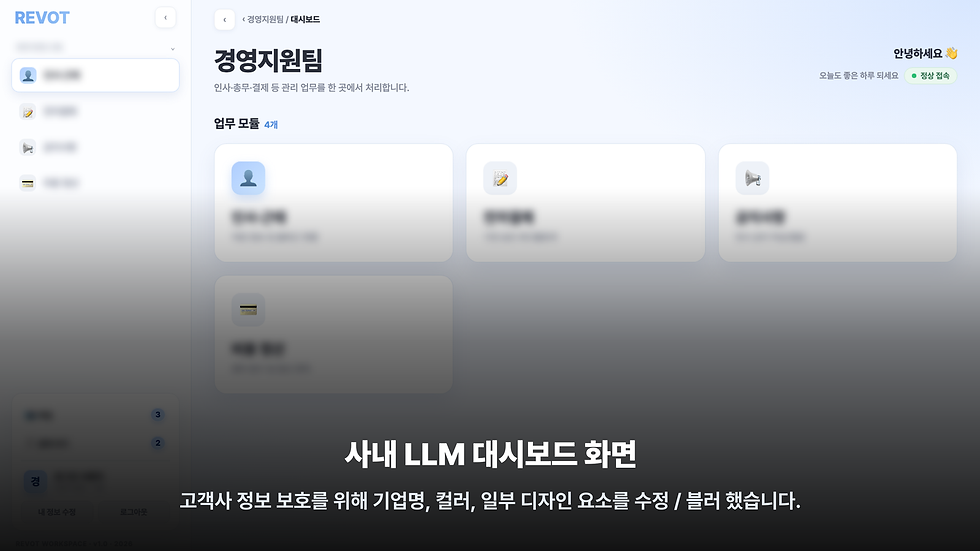
We decided to organize the company's business operations and data based on internal LLM and create an environment where employees can utilize AI in their actual work. This process leads to DX, which transforms existing business processes into digital formats , and AX, which redesigns work and organizational methods centered around AI .
Following this special lecture on generative AI, the company decided to form an AI adoption task force, implement in-house LLM, and promote DX and AX together.
Rebot is currently proceeding with this process with the company.
We are not yet at the stage where all results have been obtained. The in-house LLM implementation has not been completed, nor have specific productivity outcomes been verified.
However, it is clear that the discussions initiated in education led to actual organizational structure and implementation decisions, and that execution for the company's DX and AX has begun.

Can a single training session determine a company's adoption of AI?
A company's AI adoption is not completed with just a single training session.
Generative AI education is not about building the technology itself, but rather a starting point that enables the company and its employees to look in the same direction.
If employees do not understand why AI should be introduced, the system may not be used in actual work even if it is built. Conversely, if members agree with the necessity and direction of the change, AI adoption can move from technical review to actual implementation.
In this case as well, education did not solve all the problems.
However, through training, the company and its employees came to understand the necessity of adopting AI together, and as a result, concrete decisions were made to form a TF team, introduce in-house LLM, and promote DX and AX.
The role of this special lecture was precisely to create that beginning.
How did this case serve as a starting point for Rebot's manufacturing AI business?
This case is not simply an instance where Rebot conducted a generative AI lecture.
This is the first record of our journey together, starting with employee training for a certain manufacturing company, establishing an organization for AI adoption, implementing in-house LLM, and actually driving DX and AX.
Reebot has been solving corporate problems based on AI technology and field application experience.
This course also serves as a starting point for expanding that experience into the implementation of in-house LLM and DX·AX services in the manufacturing sector .
However, in this article, I do not intend to predetermine the services or results that will be provided in the future.
The facts that can be confirmed at present are clear.
Reebot conducted a special lecture on generative AI for employees of a manufacturing company from May 14 to 16.
Following the training, the company formed an AI adoption task force and decided to implement in-house LLM and promote DX·AX.
And now, that process is actually underway.
Where should manufacturing companies start adopting AI?
The adoption of AI by manufacturing companies may not start with purchasing technology first.
We must first understand together why the company intends to introduce AI, how employees are accepting this change, and what kind of environment is needed to safely utilize company data.
In this case, the first step was generative AI training.
Through training, the perceptions of employees changed, and the company formed an AI adoption task force. Subsequently, it decided to implement in-house LLM and promote DX and AX.
Education, organization, technology, and execution are connected as a single flow.
Rebot intends not to leave this course as a mere educational achievement.
Going forward, I plan to continue documenting how the introduction of in-house LLM and DX·AX in manufacturing companies actually proceed, what problems are encountered, and how they are resolved.
This post is the first record.

Comments