

Key Information You Must Know Before Introducing AI Vision Inspection
Updated: Aug 10
From shooting conditions and defect standards to the reasons for problems after implementation and criteria for selecting AI vision inspection companies

Key Information Before Introducing AI Vision Inspection includes whether the inspection target can be captured consistently by the camera, whether there is sufficient space to install cameras and lighting on the existing equipment, and which defects will be detected and according to what criteria.
Vision inspection relies on visual information captured in images or video. Therefore, if algorithms or equipment are selected without thoroughly evaluating the inspection target and production environment, problems may arise in the actual production process after implementation.
This REVOT's 'AI Vision Information' answers the following three questions.
What Needs to Be Prepared Before Introducing AI Vision Inspection
What is the reason why vision inspection, which was said to be possible, fails after implementation?
What criteria should be used to select an AI vision inspection company?
What Key Information Should You Check Before Introducing AI Vision Inspection?
Before introducing AI vision inspection, the first thing to check is whether the area to be inspected can be stably captured by a camera .
Vision inspection determines good and defective products based on information contained in photos or videos. Therefore, even if a person can see a defect with the naked eye, it is difficult to make a judgment using vision inspection if the relevant area is not sufficiently visible in the camera image.
The information captured in the image may vary depending on the location, orientation, surface condition, and shooting angle of the object being inspected. Before reviewing AI algorithms, you must first verify whether the features to be inspected are distinguishable in the actual image.
Can cameras and lighting be installed on the existing production line?
After confirming the feasibility of photographing the inspection subject, you must verify whether there is physical space on the existing production line or equipment to install cameras and lighting .
Stable images can be obtained only if the camera is positioned to view the inspection area and the lighting is positioned to illuminate the target. If installation space is insufficient due to the existing line or equipment structure, vision inspection equipment may need to be manufactured and installed separately.
Therefore, the feasibility of introducing AI vision inspection cannot be judged solely by algorithm performance. First, it must be reviewed whether it is possible to install the recording device on the actual production line and secure stable video.
What should I prepare before introducing AI vision inspection?
There are three key conditions that must be prepared before introducing AI vision inspection.
Confirmation items | Things to check |
|---|---|
1. Whether filming is possible | Are the parts to be inspected and defect characteristics stably captured in the camera footage? |
2. Installation space | Is it possible to install cameras and lighting on the existing production line? |
3. Judging Criteria | What conditions should be considered defective, and to what extent should detection be performed? |
Only when the first and second conditions are met can we specifically discuss which vision inspection method is suitable.
The client must clearly define which defects will be detected and by what criteria. Subsequently, vision inspection experts can analyze and design the inspection method and system structure based on the presented process and defect structure.
To what extent should the criteria for determining defects be set?
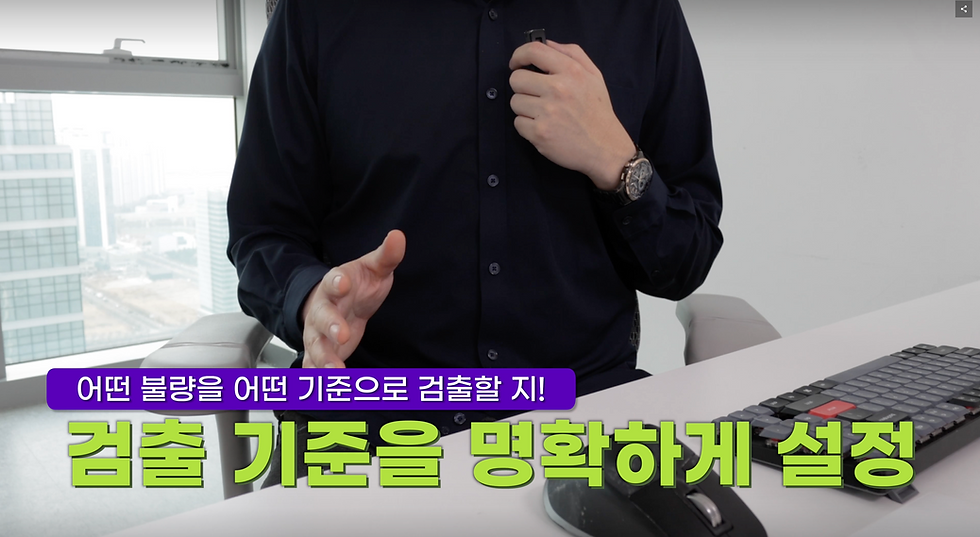
The most important information the client company needs to prepare is which defects will be detected and by what criteria .
You do not need to present the algorithms or inspection methods to the vision inspection company in advance. Instead, you must clearly communicate the criteria for what is considered normal and what is judged as defective.
Once the detection targets and defect criteria are determined, vision inspection specialists can analyze the relevant process and defect structure to design appropriate shooting conditions, preprocessing methods, algorithms, and judgment structures.
If defect criteria are unclear, it is difficult to determine success even after inspection results are obtained. This is why the process of establishing judgment criteria is necessary before implementation.
Several companies claimed it was possible, but what are the reasons for problems arising after implementation?
The main reason problems occur after the introduction of vision inspection is that feasible methods are not distinguished from methods suitable for the relevant process .
The feasible method means that vision inspection companies can create inspections using existing algorithms or standardized platforms. However, the fact that it is technically feasible does not mean that it operates reliably in actual production environments.
Existing inspection methods may not be applicable if product characteristics, defect structures, or environmental conditions change. Even methods that worked well under frequently handled conditions may reveal their limitations if the inspection target or production environment changes even slightly.
When introducing AI vision inspection, you must verify not only "Is inspection possible?" but also "Is this method suitable for this process?"
Is there a single vision inspection technology that can be applied to all processes?
There is no universal vision inspection technology that can solve all processes and all defects in a single way.
There are various approaches to vision inspection, including rule-based and AI methods. While specific algorithms or standardized inspection platforms can operate effectively with familiar products and conditions, it is difficult to guarantee the same results when product characteristics, defect structures, and environmental conditions change.
The key issue here is not the performance of the algorithm itself, but whether the inspection method was designed to fit the process .
Depending on the detection target and defect characteristics, a rule-based approach or an AI approach may be suitable. If necessary, multiple algorithms should be combined, and the entire process from image preprocessing to the final judgment structure must be designed together.
The important thing is not to determine a specific technology first and then apply it to the process, but to find the inspection structure most suitable for that process.

How are 'possible tests' and 'suitable tests' different?
A feasible inspection is an inspection that can produce results using proprietary technology or existing platforms. A suitable inspection is an inspection designed to operate stably in the actual process by analyzing products, defects, and the production environment.
division | Possible tests | Inspection suitable for the process |
|---|---|---|
starting point | The company's technology and existing platforms | Product characteristics, defect structure, and environmental conditions |
Design method | Apply the existing method | Design inspection structure to suit the process |
algorithm | Centered on a specific method | Review of rule-based and AI methods and various algorithms |
Scope of consideration | Detection implementation feasibility | Capture, preprocessing, algorithm, judgment structure |
target | Implementing the test | What operates in the actual production site |
Before introducing AI vision inspection, rather than simply checking what the company possesses, you must verify whether they can explain which inspection method is suitable for your process.

Is it sufficient to just check implementation cases from AI vision inspection companies?
Whether an AI vision inspection company possesses similar implementation cases is an important factor in the decision-making process. However, there are limitations to determining whether a company is suitable for our process based solely on such cases.
Even within the same industry or with similar products, production line structures, inspection locations, defect characteristics, and on-site environments can vary. The fact that similar cases were handled in the past does not guarantee that the same inspection methods can be applied to current processes.
When reviewing implementation cases, you should check the following information along with the result screen, rather than just looking at the result screen.
Do you ask specific questions about existing production lines and equipment conditions?
Are you trying to understand the inspection targets and the defect occurrence structure?
Explain why the relevant inspection method and algorithm are suitable.
Do you go beyond simply applying the existing platform and design the program structure as well?
Case studies are a starting point, and the actual judgment should be based on how specifically the company analyzes our products and processes.

What criteria should I use to select an AI vision inspection company?
You should select an AI vision inspection company based on whether they can design an inspection system from scratch based on your products and process conditions .
It is recommended to check the following questions during the company consultation process.
vendor selection criteria | Questions to check |
|---|---|
Understanding the field | Do you specifically verify the environmental conditions of the product and the existing production line? |
Defect analysis | Is the approach based on defect types and the structure in which defects occur? |
Method selection | Can you explain why the relevant inspection method and algorithm are suitable? |
Custom design | Is the program structure designed to fit the process, rather than simply applying an existing platform? |
Initial completion | Do you prioritize design completeness at the implementation phase rather than repetitive modifications after operation? |
While it is important what technology the company possesses, they must be able to explain how they will apply that technology to our process.
Can't vision inspection be adjusted by continuously modifying it after implementation?
Vision inspection is a system where the results are determined by how accurately it was designed during the introduction phase , rather than a system that is repeatedly adjusted and refined during the operation phase .
If the shooting conditions, defect criteria, production environment, preprocessing methods, algorithms, and judgment structures of the inspection target are not sufficiently reviewed in the initial stages, problems may recur even after operation.
This does not mean that post-incident response is unimportant. However, if implemented on the premise of post-incident correction alone, it may lead to the continuous need to refine an inspection structure that does not suit on-site conditions.
The quality of AI vision inspection depends on how deeply the process and defect structure are understood before implementation, and whether it is customized from the start.
When will the results of the AI vision inspection implementation be determined?
The results of AI vision inspection are determined largely during the initial design phase , rather than after actual operations have begun .
Whether the inspection area can be properly imaged, whether the installation conditions of the camera and lighting are suitable, whether defect criteria are clear, and whether inspection methods and algorithms appropriate for the process have been selected directly affect the final result.
If you are considering implementing vision inspection, you should first check the following questions rather than just asking, “Has this company handled similar cases?”
Can this company design an inspection system from scratch based on our products and production processes?
AI vision inspection is not simply about applying existing technology. It is about designing a single inspection structure, from imaging to judgment, to ensure it actually works within our processes.

Comments